ORDER FEARS CHAOS / FICTION
Some things survive being understood.
Others become worse.
An expanding body of psychological and supernatural horror fiction, where intimate human lives encounter things that refuse to be explained.
THE PUBLISHED WORKS
Two books. Different horrors. A larger reality.
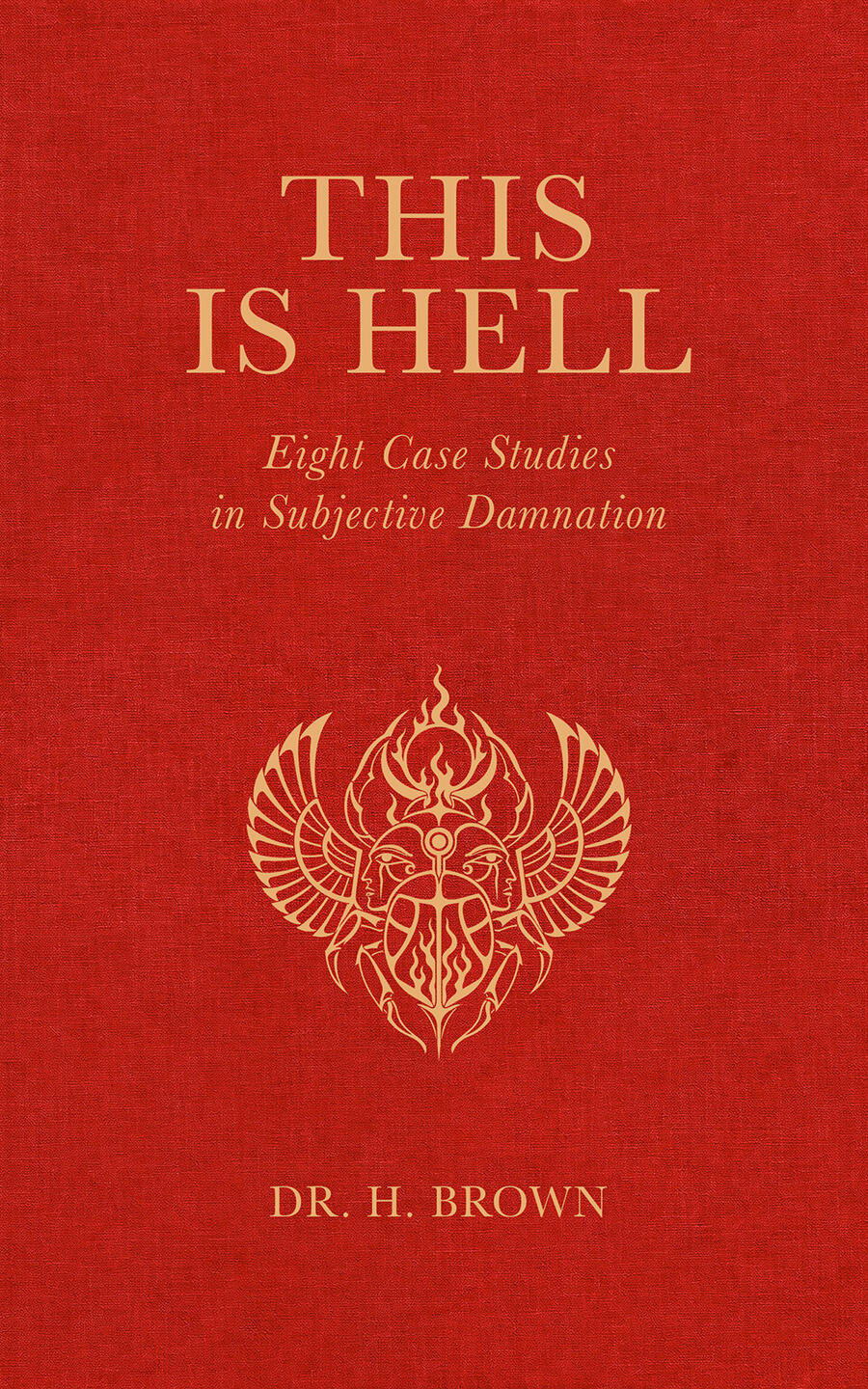
THIS IS HELL
What if damnation knew you personally?
Eight disturbing accounts of suffering in a reality where hell takes a different shape for everyone.
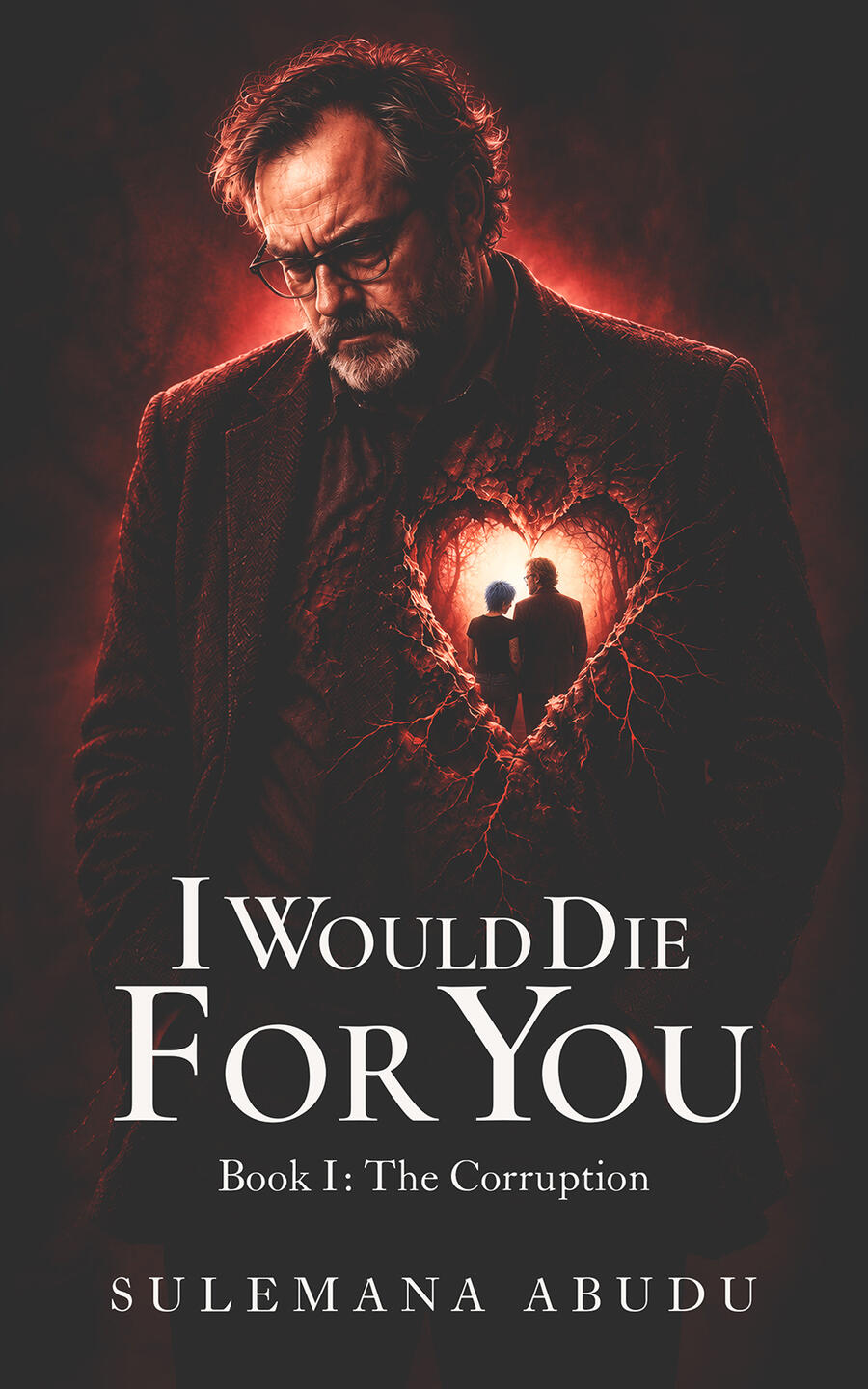
I WOULD DIE FOR YOU
How much would you sacrifice for someone you love?
An unsettling novel about love, suspicion, and a supernatural presence that turns the most intimate relationships against themselves.
THE WORKS
Stories about the terrible things people do, the things they endure, and the things that endure them.
PSYCHOLOGICAL / SUPERNATURAL HORROR
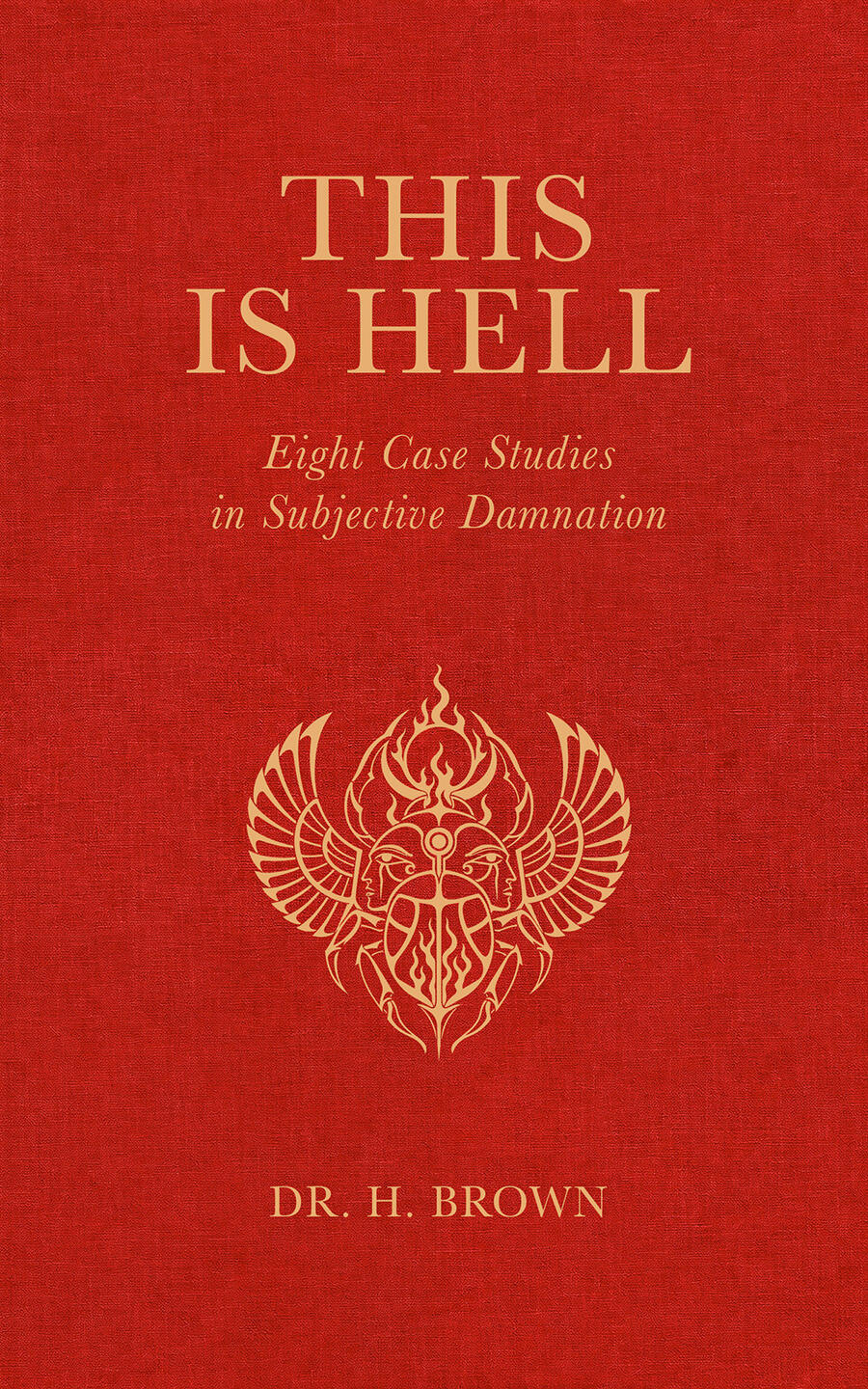
THIS IS HELL
Eight Case Studies in Subjective Damnation
What if hell knew you personally?
In 1983, Dr. Hannibal Brown disappeared. Forty-two years later, he returned, carrying memories of a reality where suffering takes a different shape for everyone.Told through eight unsettling case studies, This Is Hell explores the possibility that damnation is not a place, but an experience designed around the individual.
PSYCHOLOGICAL / SUPERNATURAL HORROR
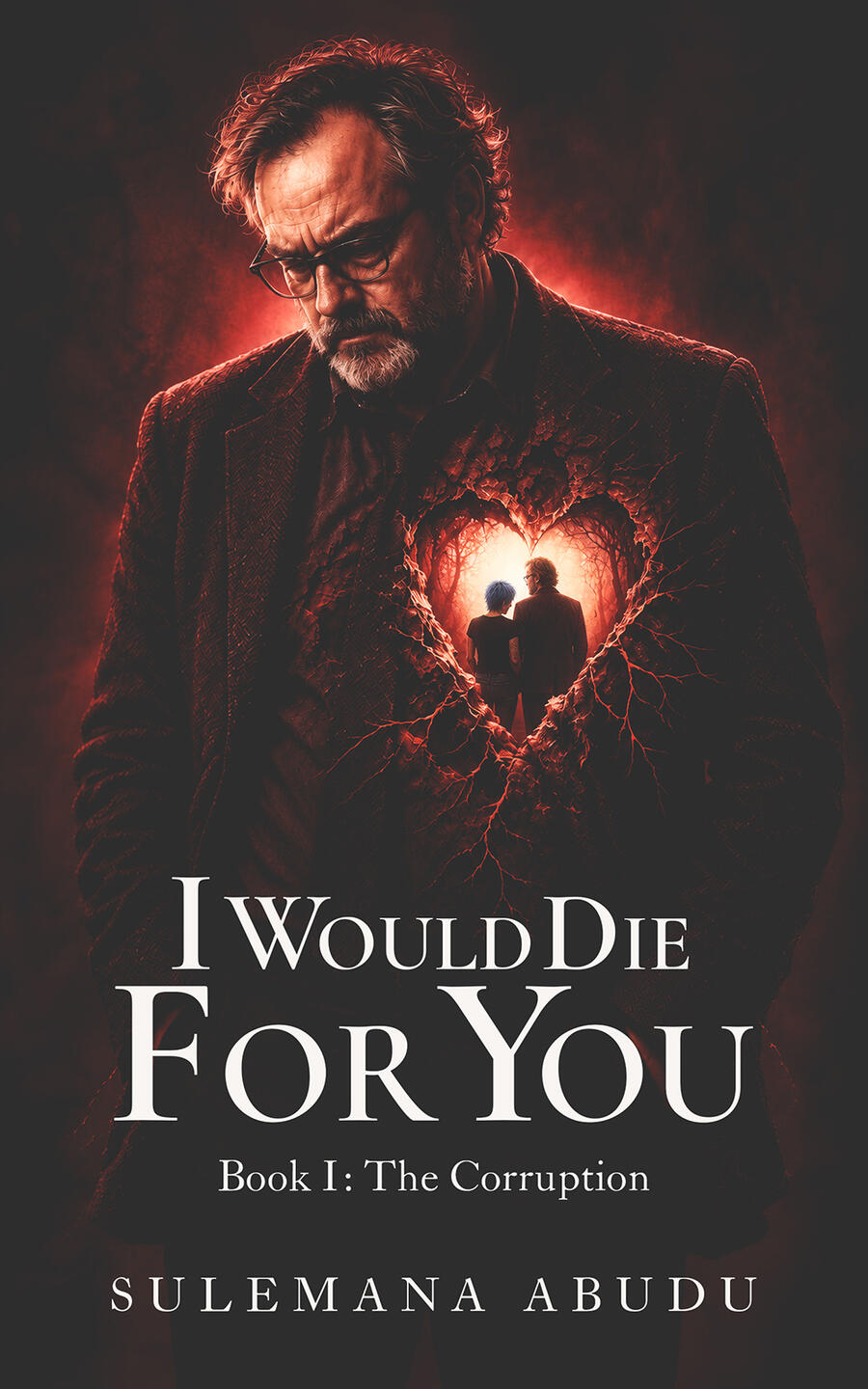
I WOULD DIE FOR YOU
Book I: The Corruption
How far would you go to protect someone you love?
When Harold Callahan acquires a mysterious red book, his life begins to unravel.As an increasingly malevolent presence exploits his fears and insecurities, the people closest to him become entangled in a struggle where love, loyalty, and suspicion can no longer be separated.A novel of supernatural horror about the things we sacrifice for the people we love, and what happens when those sacrifices become weapons.
THE RECORD
There are stories that end when the final page is turned.Others leave things behind.The Record contains selected fiction, illustrations, correspondence, and other material from the world of Order Fears Chaos.Some entries stand alone. Others may be more familiar than they first appear.
FEATURED ENTRY / 001
Before the Disappearance
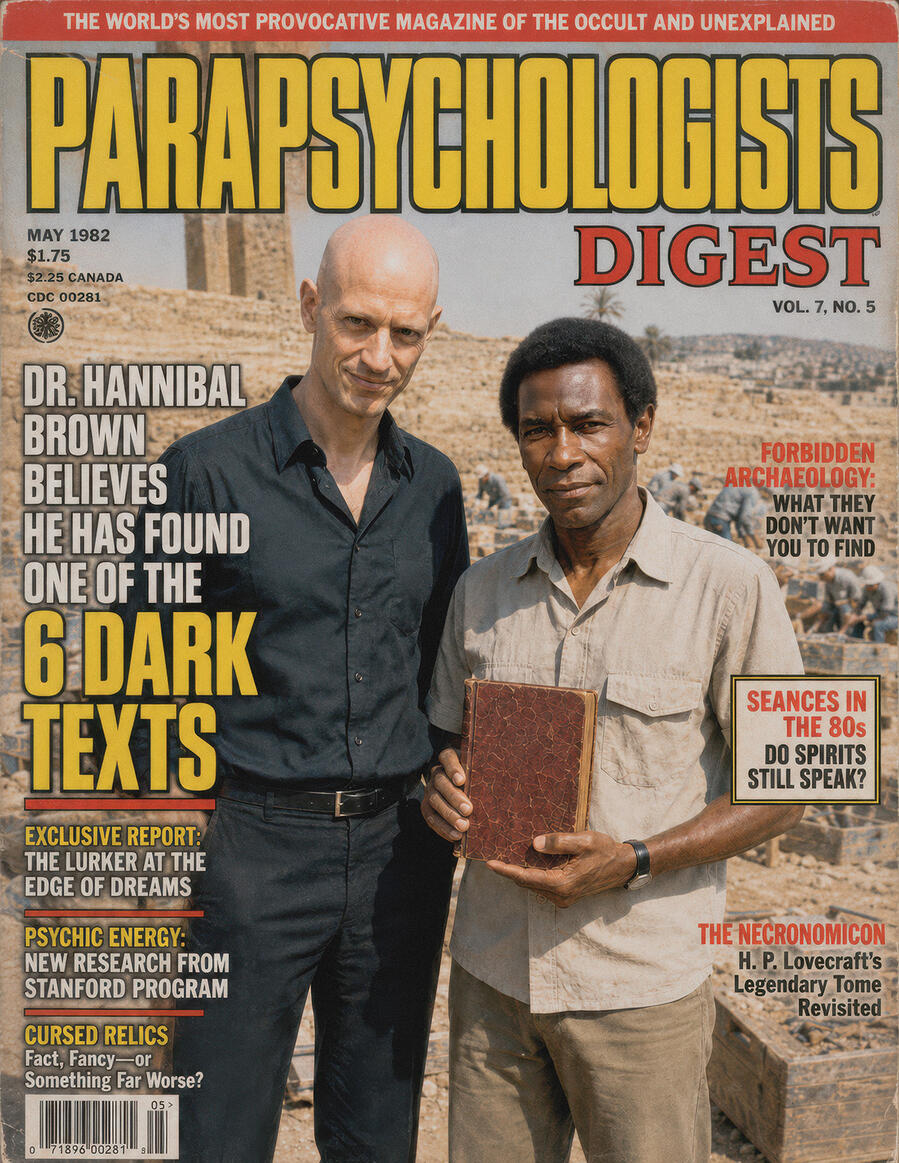
In May 1982, Dr. Hannibal Brown appeared on the cover of a magazine devoted to the occult and unexplained. The man standing beside him would become part of a mystery that remained unresolved for more than four decades.

VISUAL STUDY / 002
The Shape of Suffering
Five unpublished drawings from Dr. Hannibal Brown’s case materials.
CONVERSATION / 003
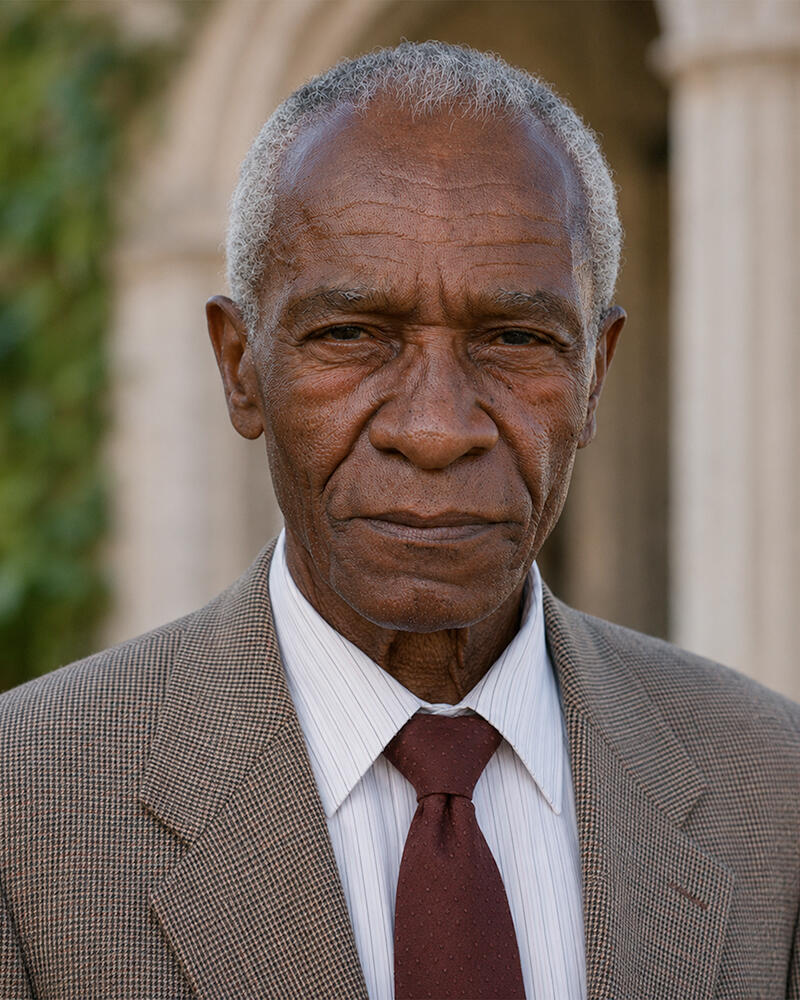
A Conversation with Dr. Brown
In June 2025, shortly after his unexplained return, Dr. Hannibal Brown agreed to an interview. He answered some questions. Others, he refused to answer.
Fictional interview · Audio and transcript
Further correspondence
New fiction and occasional material from Order Fears Chaos are published throughout the year.Readers may receive future entries by email.
CORRESPONDENCE
There is more to tell.
Order Fears Chaos publishes occasional fiction and material extending beyond its books.Receive original short works, illustrations, strange observations, and early news of future publications.Approximately two messages per month.Free to subscribe. Leave whenever you wish. No unrelated promotions.
THE PUBLICATION
ABOUT ORDER FEARS CHAOS
Some stories refuse to remain separate.
Order Fears Chaos is an independent literary project created by Sulemana Abudu.Its fiction explores the fragile boundaries between ordinary life and the impossible, where intimate relationships, personal histories, and the desire to understand can become sources of horror.The published works include I Would Die For You: Book I, The Corruption and This Is Hell: Eight Case Studies in Subjective Damnation.Each story can be approached independently. As the collection grows, connections emerge between events, places, and people who may understand less about their circumstances than they believe.Beyond the books, Order Fears Chaos publishes occasional fiction, illustrations, and related material.
SULEMANA ABUDU
Creator and author of Order Fears Chaos
THE RECORD / ENTRY 001
Vol. 7, No. 5
A careful man on a careless magazine, standing beside someone no other record mentions.
In May 1982, Parapsychologists Digest cost a dollar seventy-five and was sold near the chewing gum. That month’s cover promised a fresh look at the Necronomicon, an update on séances, and new research into psychic energy. Down the left side, in the largest type on the page, it announced that Dr. Hannibal Brown believed he had found one of six dark texts.
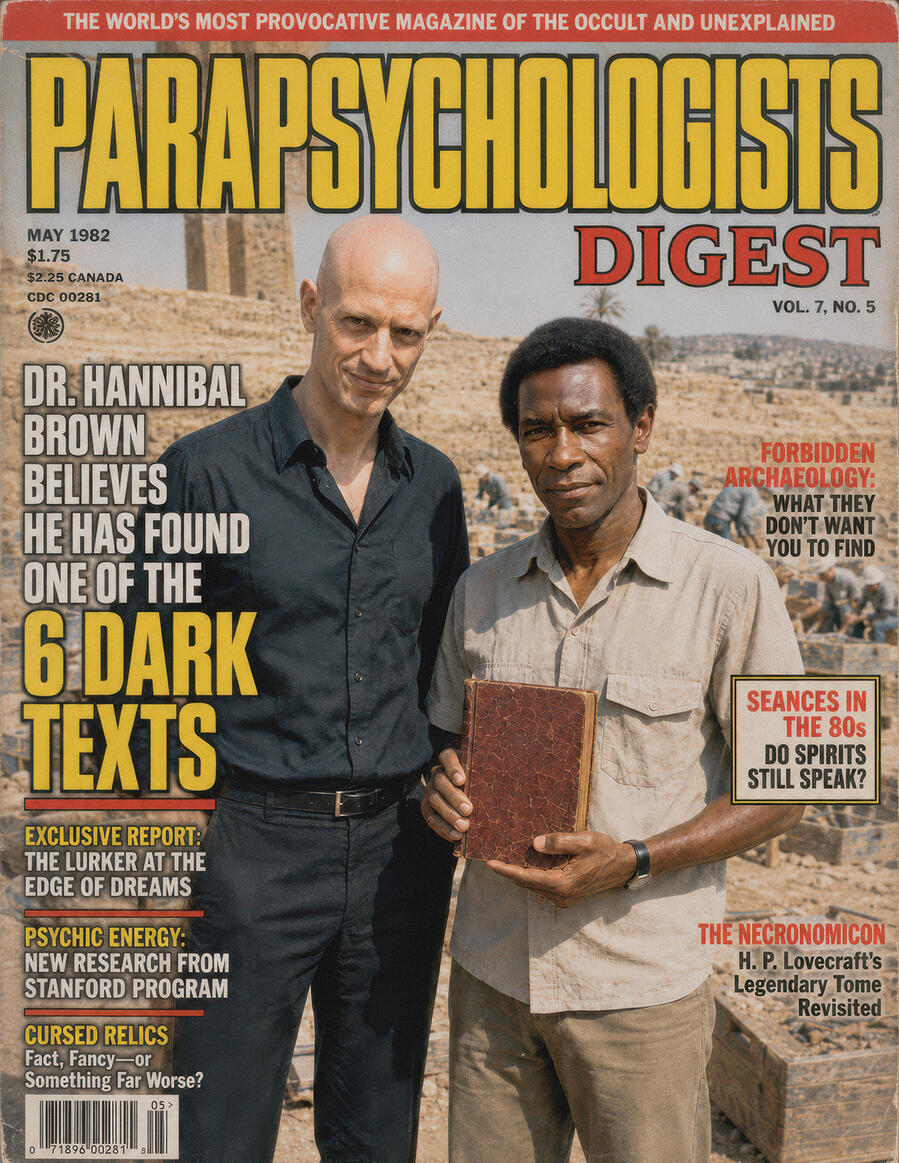
To anyone who knew Brown’s work, the strange part of that sentence was not the six texts. It was the word believes.Brown was twenty-eight. He had taken his doctorate at twenty-five, from a department that no longer exists. In the three years since, he had investigated dozens of claimed hauntings, apparitions and survivals, and explained nearly all of them. His reports were short, dry and full of qualifications. In a field crowded with enthusiasts, he had made his name by declining to be one.He was also one of very few Black researchers in a discipline that universities were already quietly abandoning. He seems to have understood early that his credentials would be scrutinized more closely than those of his colleagues, and he spent his credibility carefully.That is why the cover is hard to explain.The photograph was taken at an excavation. The magazine does not say where. The light is hard and nearly white. Behind the two men, workers bend over shallow trenches. Brown wears a pale work shirt and a wristwatch, and holds against his body a book bound in red. He looks pleased, like a man who has decided not to smile and has nearly managed it.The man beside him is taller and dressed in black, with his sleeves down despite the heat. The caption gives his name as M. Voss. It gives no title or affiliation, and no reason for his being there.Brown spent the following year studying the book. He published nothing about it. People who worked near him that year remembered him as preoccupied. In October 1983 he was reported missing. There was no sign of struggle at his office or his home, and nothing had been taken. After an interval he was presumed dead.What happens after is what sometimes happens when a promising researcher disappears from a field already struggling for legitimacy, he became a lesson. The lesson was that he had asked one question too many, and the cover became its illustration.Voss became nothing at all. No address, no employment and no death has ever been found for a man of that name and description. Apart from the caption, the photograph is the only record that he was there.It is worth looking at the photograph again, and not at the book.The sun is almost directly overhead. Brown is squinting into it.Voss is not. He looks straight into the lens, entirely at ease, like a man who has been asked to stand still for a photograph many times before and has never minded.
FURTHER READING
Dr. Brown's own account of May 1982 appears in the introduction to This Is Hell.
THE RECORD / VISUAL STUDY 002
The Shape of Suffering
Five unpublished drawings from Dr. Hannibal Brown's case materials
Dr. Hannibal Brown had no training as an artist and, by his own account, no aptitude. He drew because he had a pencil and no camera, and because accurate rendering was, he wrote, “the only form of composure available to me.”
The drawings reached his publisher separately from the manuscript, in a paper grocery bag. Most were reproduced as plates in This Is Hell. Some were not. Five of those are shown here.
They should be looked at with one limitation in mind. A drawing records what the observer saw. The cases concern what the subjects felt. Brown was aware of the distance between the two, and seems to have spent much of his time trying to draw across it.
CASE 01
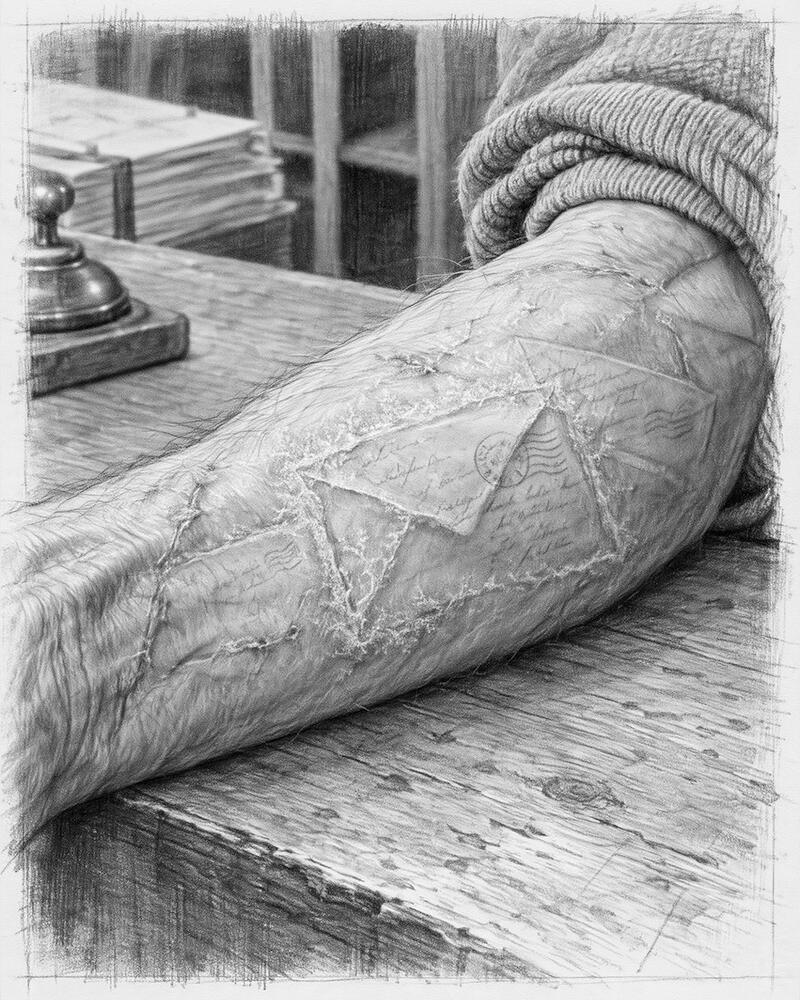
The forearm, eighth day.
Each shape is an envelope, and every envelope is addressed to the man whose arm this is. On the day this was drawn, eleven of them formed. Brown drew the stamps and the postmarks with great care. He did not try to read the letters.
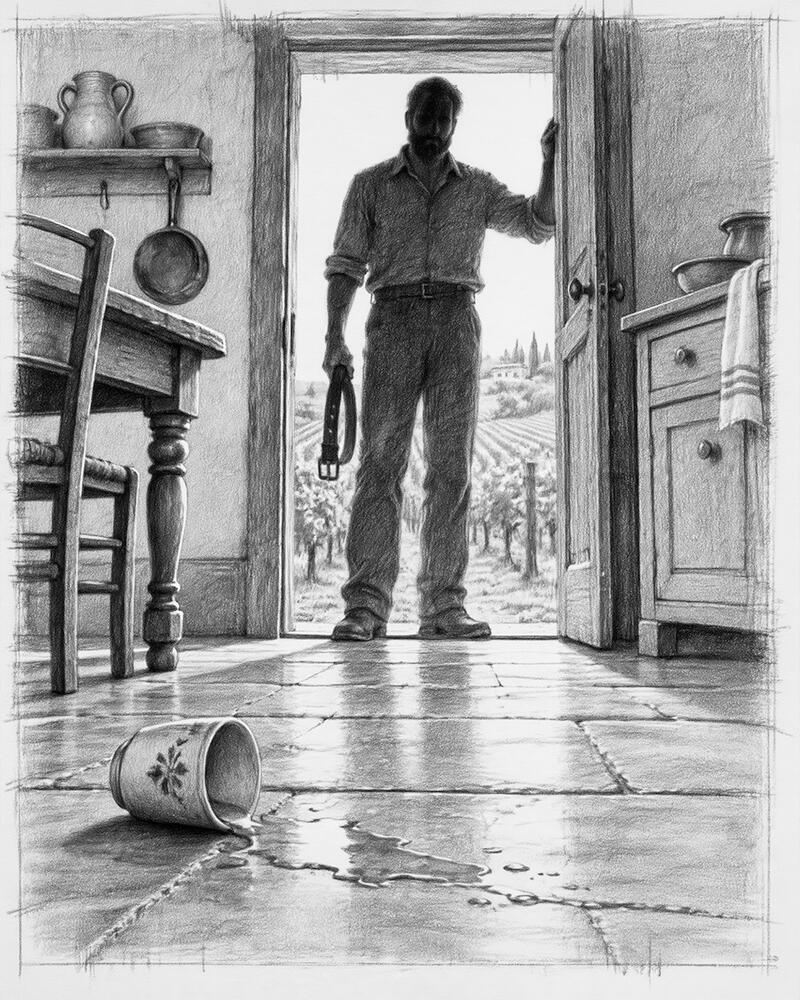
CASE 04
The kitchen door, morning.
This is the only drawing in the group made from the height of a child. The subject was twenty-two. Brown did not explain the angle.The cup on the floor does not appear in the case as an object. It appears as a rule.

CASE 06
The family, assembled.
Each person here is someone the subject spent eleven years waiting to see again. Each is exactly as she remembered them, and says exactly what she hoped they would say.Brown drew their eyes last, and more than once.One person she was waiting for is not in the drawing.
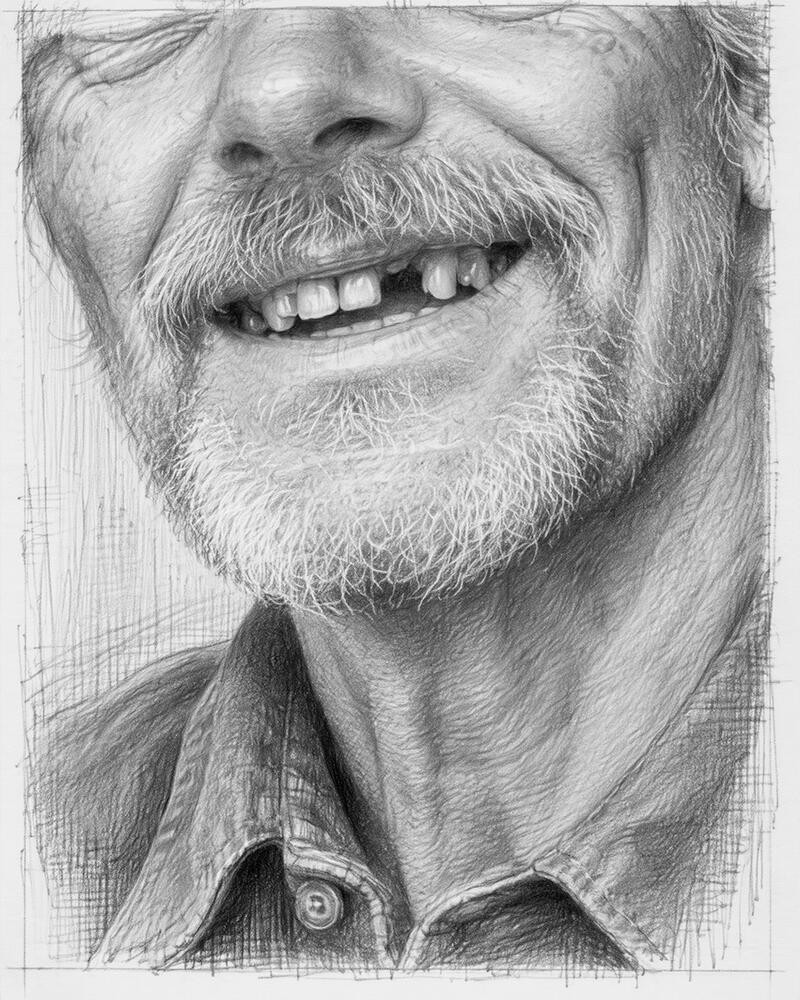
CASE 09
The father, Saturday.
He is not in pain in this drawing, or not only. Brown records that he was proudest on the days he paid the most.The gap will close in about a month. That is not the good news it appears to be.
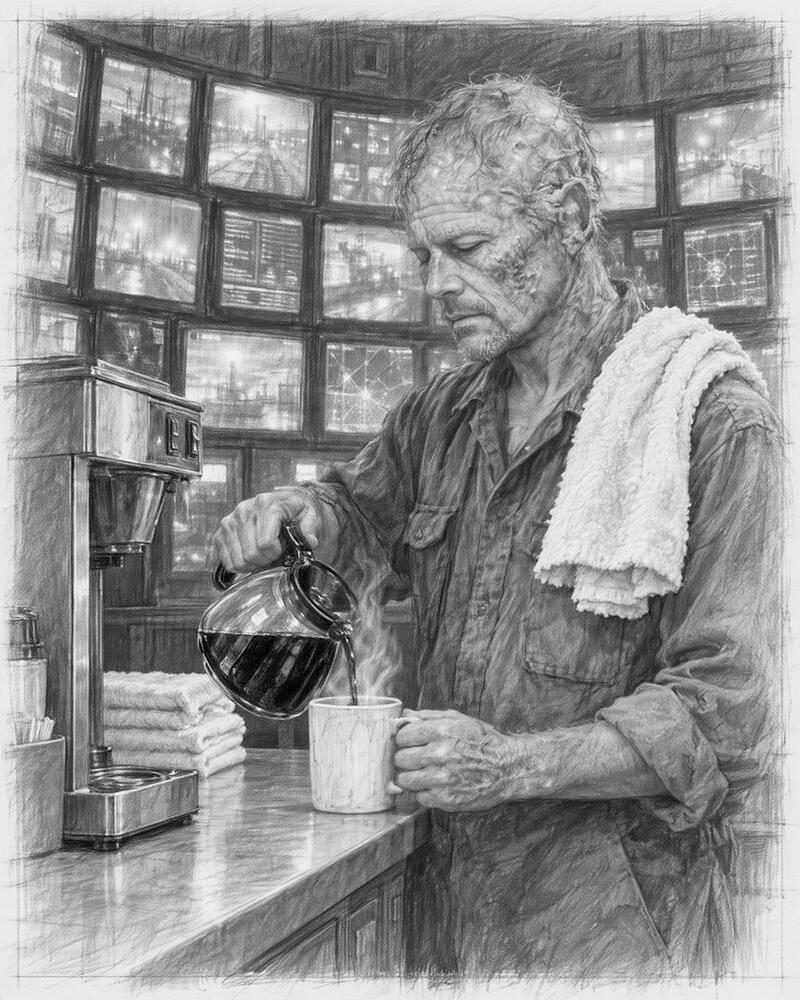
CASE 16
The coffee machine.
These burns were not there an hour before this drawing was made, and they will be gone a few hours after. Brown drew him at the only task in that room that costs him nothing.He does not hurry it.
None of these drawings shows the worst thing in its case.
Brown seems to have decided early on that the worst thing was not his to draw.
FURTHER READING
Further accounts of Dr. Brown's observations appear in This Is Hell: Eight Case Studies in Subjective Damnation.
THE RECORD / CONVERSATION 003
A Conversation with Dr. Brown
June 2025. An interview conducted shortly after his return.
In June 2025, some weeks after his return, Dr. Hannibal Brown agreed to speak with a journalist for a regional newspaper. The conversation took place in a rented room near the county office where he was then completing his documents. It was not published at the time.The interviewer recorded the conversation, and the recording is presented here with the transcript, edited for length. The interviewer asked not to be named.
TRANSCRIPT
Thanks for doing this. Please, sit. Anywhere you like.I'm fine. Thank you.Oh. Okay. So. You've been described as one of the pioneers of your field.By whom?By several of the people who wrote about you while you were gone.Then they were being generous to a man who couldn't correct them. I worked for four years. I investigated sixty-one cases and explained fifty-eight. That isn't a pioneer. That's a man with a filing system.And the other three?Two were poorly documented. The third, I couldn't account for.What was it?I didn't publish it then. And I don't see that the years since have improved the evidence.People want to know where you were.Yes. So do I.I've tried to write it down. I have perhaps forty versions of the sentence, and every one of them describes a crossing. A door. A darkness. A fall. I don't remember a crossing. If I give you one, you'll print it, and it will be the only account anyone has. And it will be false.You say you experienced about two years.About two. My body has kept a different count. I'm told that's impossible. I'm usually told so by people kind enough not to mention that I'm standing in front of them.Were you alone?No.Who was with you?I'd rather be accurate than complete. I wasn't alone. And I was never addressed. No one explained anything to me. I want that understood. Because people will want me to have met someone who did.Are you sure you don't want to sit down? We've got a while.Quite sure. Thank you.The man in the photograph. Voss.He was courteous.That's all?It's the only thing about him I'm certain of. I asked him a great many questions, over the course of a year. I couldn't afterward repeat a single one of his answers. I've thought about whether that's because he didn't answer. Or because I can't. I haven't decided.And the red book?I'd rather not discuss the book.Is that because—It's because I'd rather not.You were married.For eight months.I'd like her left out of a newspaper. She has had forty-two years of being left out of my decisions. She can have this one.You've started drawing.I had a pencil and no camera. My hand shakes when I write. You'll have noticed. It doesn't when I draw. Three physicians have found that interesting.What do you draw?What I saw. As accurately as I can. It's the only discipline I have left that still works.Will you publish?I recorded what I saw. Whether that was for anyone else, I'm not sure. I'm no longer sure it was for me.A lot of people would say you're fortunate. You came back.People have said so. A woman at the county office said so this morning. She meant it kindly.I can't find the door I came out of. A man who doesn't know how he left a place hasn't much reason to believe he has.Is there anything you're afraid of now?Being wrong about this. And being right about it. In roughly equal measure.
The interviewer's notes record two further details. The room had been booked for one hour, and Dr. Brown arrived early and checked the clock on the wall against his own watch, twice. And although he was offered a chair at the start of the conversation, and again halfway through, he remained standing until it ended.Dr. Brown's own account of his absence was later published as This Is Hell: Eight Case Studies in Subjective Damnation.
FURTHER READING
Dr. Brown's account of his absence appears in This Is Hell: Eight Case Studies in Subjective Damnation.